PRODUCT DESIGN · FA · PRODUCT DESIGN · FA ·
TD Bank Cybersecurity Report All Work

01Information Architecture

TD Bank Cybersecurity Report

Annual Report Design for TD Bank

Client
TD Bank
Year
2024
Role
Design Lead, Publication and Information Design
88,000+
Employees Reached
3
Audience Types, One System
Annual
Scalable System
Project Details
Client
TD Bank
Year
2024
Role
Design Lead, Publication and Information Design
Tools
Figma · Adobe InDesign · Adobe Illustrator · Adobe Photoshop
88,000+ employees · Multi-audience system
Overview

The report was trying to be one thing for three fundamentally different readers, and succeeding for none of them.

TD Bank's annual cybersecurity report reached 88,000 employees but was not working for any of them. Executives could not scan it for direction. Teams could not extract operational priorities. Frontline employees found it too technical to act on. I redesigned it as a layered information system where each audience could find what they needed without the report failing the others.
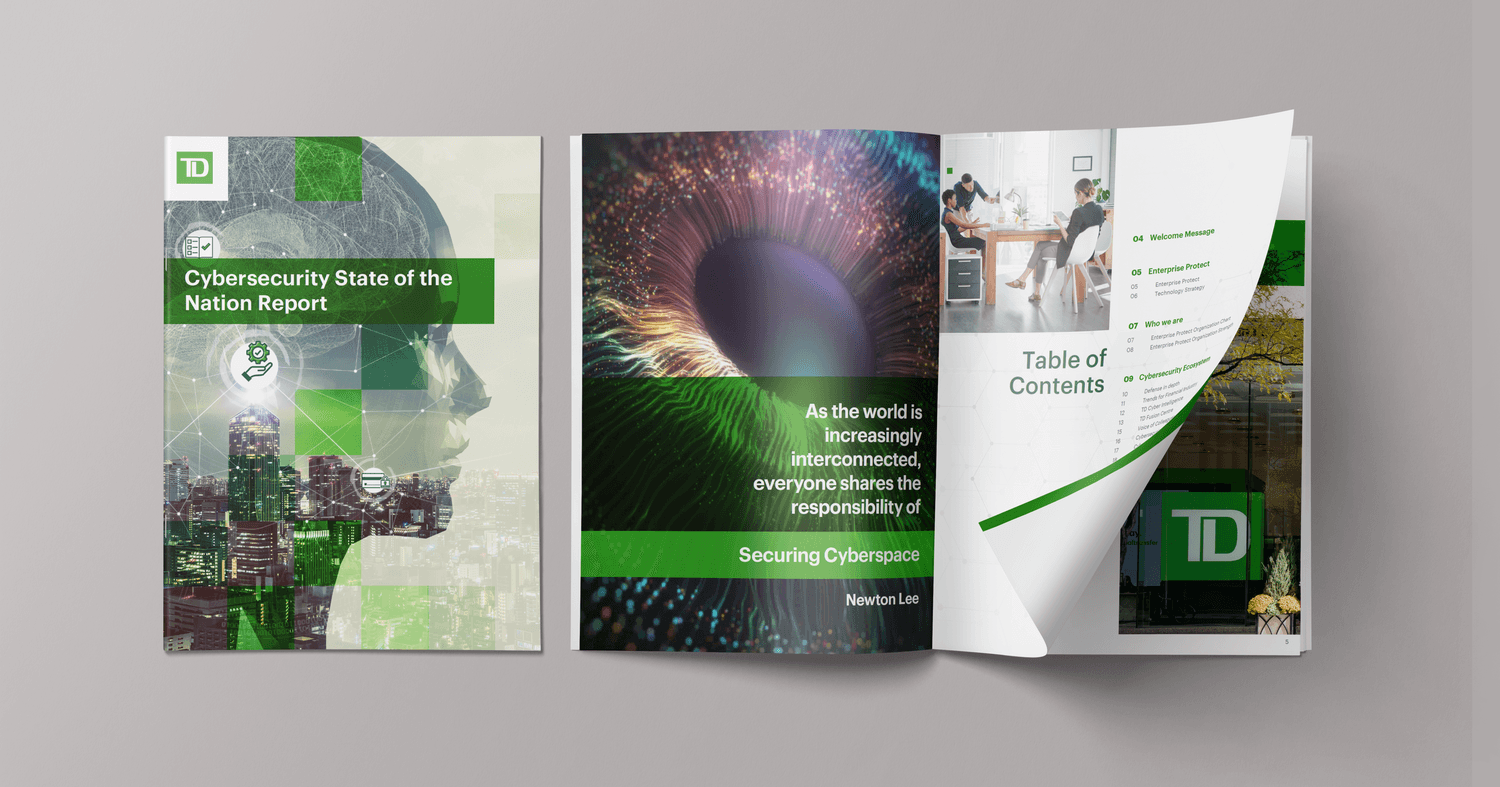
TD Bank Cybersecurity Report – overview
TD Bank · Information Architecture01
The Challenge
  • Executives needed strategic signals in under 60 seconds. The existing format buried them in operational detail.
  • Team leads needed clear priority frameworks. These were scattered across the document with no consistent structure.
  • 88,000 employees needed practical, human guidance. Technical language made the content inaccessible to most of them.
  • No visual hierarchy to signal what was directional versus operational versus educational.
  • No modular architecture meant every annual edition required a full redesign from scratch.
My Role

I led information architecture, visual system design, and production for the complete publication redesign. I worked directly with TD Bank cybersecurity leadership to map audience needs, define the content hierarchy, and translate their strategy into a system that served three reader types simultaneously.

Process

How I approached it

01

Audience Needs Mapping

I mapped three distinct reader profiles before opening any design software. What does an executive need in the first 30 seconds? What does a team lead need to walk away with? What does a frontline employee need to actually change their behavior? These three questions became the design brief.

02

Content Hierarchy Redesign

I restructured the information architecture to create three distinct entry points within a single publication. Executive summaries surface at chapter openers. Operational frameworks are consistently structured. Employee guidance is written and designed separately to feel human and actionable rather than corporate and abstract.

03

Visual System Construction

I built a modular layout system with seven typographic levels, consistent chapter architecture, and a visual language for representing cybersecurity concepts that prioritizes relationships and structure over decoration. Every diagram was evaluated against one question: does this make the concept clearer or just more visual?

04

Scalable Framework Delivery

I delivered a modular design system alongside the finished publication so future editions could be produced without requiring a redesign. Templates, style guides, and component documentation were part of the final deliverable.

This case study includes selected and anonymized visuals. Sensitive content has been edited for confidentiality while preserving the design system, structure, and intent.

The Solution

A layered publication redesigned as an information product with three distinct reading modes built into one coherent system.

  • +Three audience entry points: executive summary, team operational brief, and employee guide, all within one publication
  • +Seven-level typographic hierarchy calibrated for both fast scanning and deep reading
  • +Visual frameworks translating cybersecurity concepts into navigable systems without oversimplifying them
  • +Modular chapter architecture enabling annual updates without full redesign
  • +Production-ready design system and templates delivered alongside the finished report
88,000+ employees · Multi-audience system
Key Decision

The decision not to simplify the cybersecurity content, but to layer it. A version written entirely for executives would have failed teams. A version written for teams would have failed frontline employees. The architecture had to serve all three without anyone feeling like they were reading the wrong document.

The Tradeoff

Modular systems take longer to build than one-off layouts. The annual scalability was not visible in the first edition. That upfront cost was the right investment, but it required stakeholder trust that the value would compound over time.

In Retrospect

If I were starting again, I would involve team leads in the content hierarchy review earlier. Their feedback in the first edition shaped several structural decisions that I arrived at too late in the process.

I had the opportunity to work with Fatemeh on a mission critical project. Her dedication, speed and collaborative skills were exceptional. She is creative, highly skilled and fantastic at communicating and interpreting complexity. I would recommend her without hesitation and look forward to working with her again.

Dwayne Matthews O.C.T  ·  Keynote Speaker, Innovation Evangelist, Future Strategist
Next Project

Little Iran Cultural District