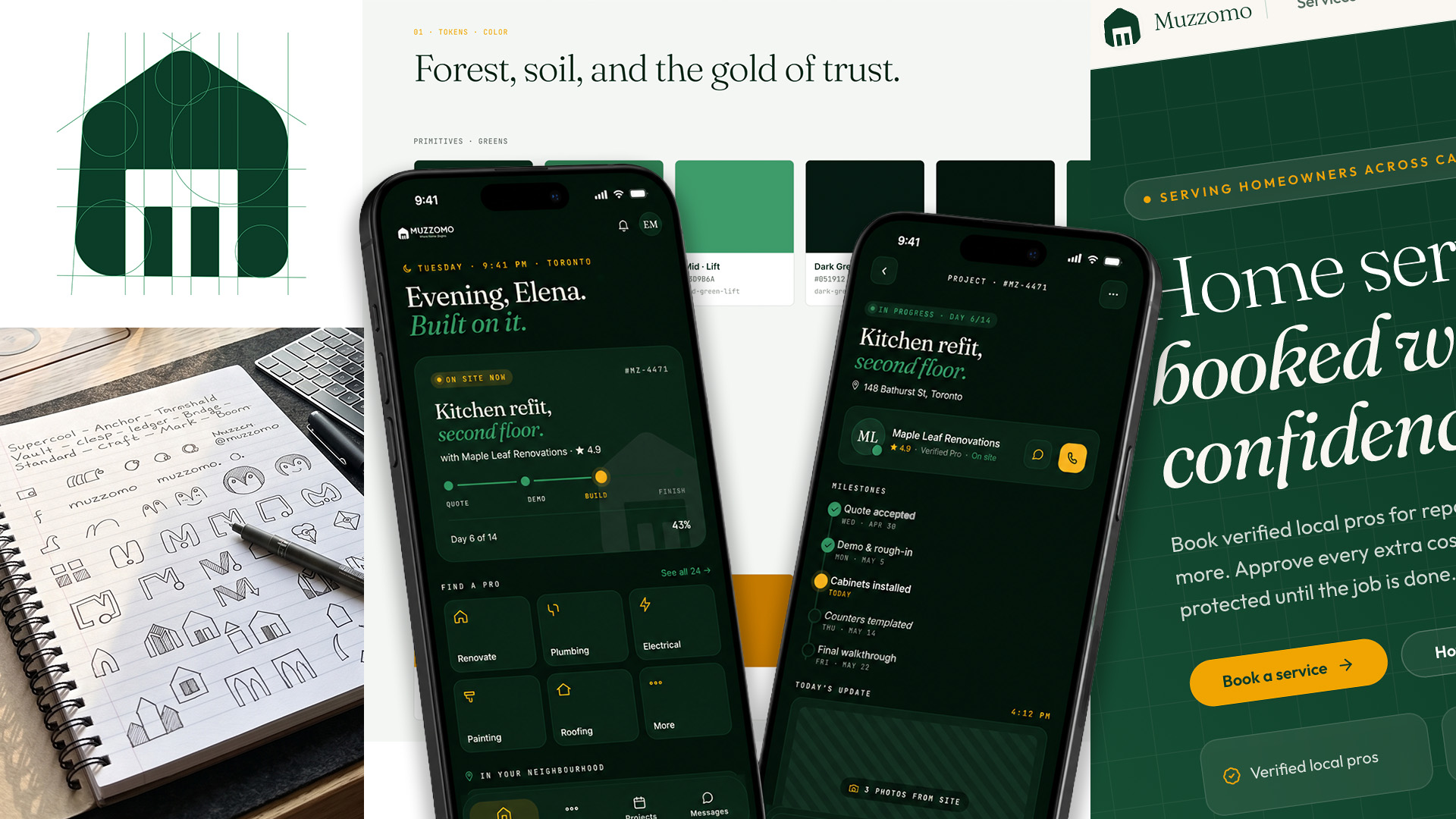
A home services marketplace lives or dies on trust. The brand had to feel as dependable as the trades it represents, without slipping into either generic-corporate sterility or folksy informality.
Muzzomo sits in a difficult position in the Canadian home services market. Mass directories are cheap but untrusted. Premium agencies are credible but inaccessible. Muzzomo is the trustworthy middle, and the brand had to express that without leaning on either extreme. I built the complete identity and product system as one continuous piece of design: foundations, mark, color, type, dark mode, and applications. The dark mode is the part I am proudest of. It is not an inversion. It is a reimagining where the brand idea actually deepens.
How I approached it
Muzzomo is currently in concept review stage. Outcomes describe the depth and completeness of the system as delivered, not post-launch metrics. The full brand book is available on request.
A complete brand and product system built as one continuous piece of design, with a dark mode that reimagines the brand instead of inverting it.
- +Strategic positioning as the trustworthy middle between mass directories and premium agencies, with a market map driving every subsequent visual decision
- +Concept system built around the home-with-open-door idea, selected from three explored directions including a rejected mascot route
- +Four logo lockups with clear-space rules, minimum sizes, and six explicit do-not patterns
- +Six-token color system with documented distribution percentages calibrated for both light and dark modes
- +Four-tier dark mode surface architecture replacing the cream-paper warmth of light mode without flattening the brand
- +Six-tier typographic ladder pairing Fraunces and Inter, with three protective rules governing italic use, numerals, and font loading
- +WCAG AA verified across all token combinations, with two tokens retired in dark mode for failing contrast requirements
- +Nineteen-page brand book delivered as a production-ready system, from foundations through applications
The decision to design dark mode as a parallel language rather than a CSS inversion. The brand idea was warmth and hospitality, and a literal inversion would have killed it. Instead I rebuilt the surface system from the ground up, retired tokens that failed the new contrast environment, and flipped the logo so the door becomes negative space. Dark mode deepens the brand instead of dimming it.
A parallel dark mode system takes significantly more work than inverting a light mode palette. Two color tokens had to be retired entirely, every contrast ratio had to be re-verified, and the logo needed a second construction. The upfront cost is real. The payoff is a product surface that does not feel like the brand turned off when the user switched themes.
The mascot direction I rejected taught me more than the one I kept. Building it fully before discarding it is what proved the door-as-M concept was actually the right answer. A token alternative that exists only to make the preferred direction look better is a waste of the work it took to build it. Both directions had to be real for the choice to mean anything.


